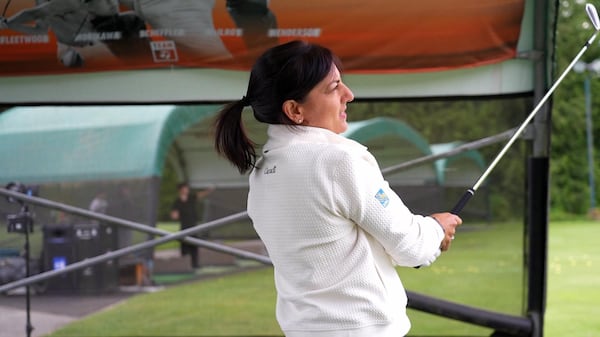
VANCOUVER – For most of her life, Salimah Mussani has relied on the lessons she’s perfected in the game of golf in order to help her conquer the game of life. “You get fresh air, you get to move, you get to be active,” she says about the sport she loves. “But yeah, this game will tear you apart.” Mussani’s journey to becoming head coach of Canada’s National Women’s Golf team is the result of an accidental twist, after years of suffering from a potentially fatal health condition no one could see. And the pursuit of her passion – golf – was exacerbating the devastating toll on her body. “I couldn’t get through workouts, class, practice without just being exhausted. Nobody knew what to do or what was happening,” Mussani said. “Doctors told me I just need to quit. But I kept going.” The condition was called immune thrombocytopenia (ITP), a rare autoimmune disorder in which the immune system mistakenly attacks and destroys platelets. It affected her body’s ability to produce platelets to clot her blood. “There was nothing to stop any type of bleeding,” Mussani said, increasing the risk of a situation where she could “just bleed to death.” The symptoms emerged the summer before she was set to start at the University of Texas at Austin on a full scholarship, which was secured as the result of major victories including wins at the Ontario and Canadian Juniors. It turns out her spleen – the small organ that stores and filters blood – was eating the platelets her body was generating. So, she had it removed. “And then my platelet count, boom, back to normal,” Mussani explained. But the relief was temporary. Halfway through her degree, there was another health setback. Mussani took a few months off, investigated what was wrong, and discovered she has lupus – a condition where the body’s immune system attacks its own tissues and organs. She finished her degree after transferring to California’s prestigious Stanford University. And despite doctors advising her to quit, and the risk to herself, she turned pro. “Two triggers for lupus are sun and stress. And that’s basically your life as a professional golfer,” Mussani said. She endured the pain that came with that decision for seven agonizing years. “My hands would be like hockey gloves… swollen. Couldn’t feel them,” she says, adding that she would faint “in the middle of a round ... [and] they’d have to call an ambulance.” Pretty soon, the choice was clear: leave the pro circuit… Or else. “My kidneys were not in good shape,” Mussani said. “I remember having a conservation with the doctor saying, ‘if you keep this up, you know, you will be on a transplant list soon.’” It’s a decision that still weighs heavily on her. Her eyes begin to well up as she talked about it. “Sometimes… you wonder, right? What your career could have been like?” When asked whether she whether she felt like she left a lot on the table, Mussani said: “Yeah, yeah. I’m very competitive.” The fixation with the sport began as a teenager for Mussani, when she tried golfing during a family vacation. A stranger shared an observation about her with her father that would ultimately change her life. “The guy says, ‘are these your children?’ and he [my father] says yes. And he [the stranger] says ‘invest in her.’” Six months later, Mussani was competing. As head coach, she’s inspiring a new generation of Canadian golf talent, such as Leah John, who joined the LPGA tour this year. She says Mussani has not only helped her game, but also how to handle life’s biggest challenges. “If you’re ever having a hard time and stuff, she can just talk about it. And she can always bring in her perspective,” John said, while recently competing in Ohio. “I just admire how she views the world and pressures and the life.” Assignment Canada profiles Canadians who are making a difference. If you’d like to nominate someone, we’d love to hear from you at assignmentcanada@bellmedia.ca