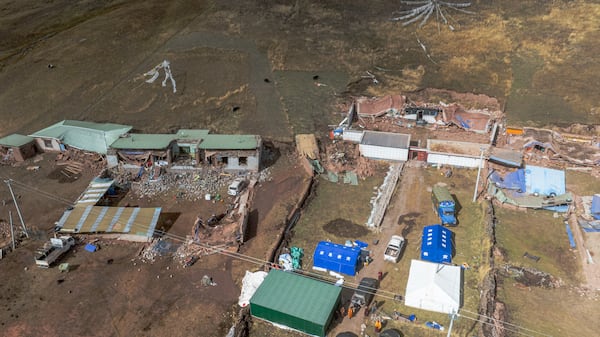
CAIRO — Rescuers in Yemen pulled more bodies from the rubble Wednesday of a prison run by Iran-backed Houthi rebels that was hit in a deadly airstrike earlier this week, as an escalation between the rebels and a Saudi-led coalition threatened Yemen’s fragile ceasefire. The renewed fighting is also threatening global oil shipments as the Houthis target shipping and oil infrastructure that’s helping keep oil flowing through the Red Sea while the U.S.-Iran war has throttled shipments through the key Strait of Hormuz on the opposite side of the Arabian Peninsula. The prison in Hazm, the Jawf provincial capital, collapsed on Monday when coalition strikes hit the area, killing at least 23 people, including the four whose bodies were found on Wednesday. It wasn’t immediately known how many people were in the prison at the time of the strikes, which also left seven people injured. Deadly prison attack sparks an escalation Following the strike on Monday, the Houthis retaliated on Tuesday with attacks on southern Saudi cities. The coalition early Wednesday responded with more strikes on rebel-held areas. The Saudi-backed government forces advanced in the eastern part of Hazm on Wednesday, cutting off supply routes to the Houthis, the military’s media office said. The rebels reported 48 airstrikes over 12 hours in the provinces of Jawf, Marib, Hodeida, Taiz, Bayda and Saada, the rebels’ stronghold on the border with Saudi Arabia. Hassan Saboula, director of Jawf’s civil defence agency, said a child was among the 23 killed on Monday and that rescue teams were still searching for seven missing from the attack. The identities of those killed have yet to be determined, al-Masirah satellite news channel cited Saboula as saying. Among the seven injured was a woman who was visiting her husband, said Anees al-Asbahi, a spokesman for the Houthi-run health ministry. In a statement Wednesday, Houthi military spokesman Brig. Gen. Yahya Saree claimed the prison strike was carried out by an F-15SA Saudi aircraft. He said the aircraft took off from King Khalid Air Base in Khamis Mushait, the kingdom’s fifth-largest city, at 4:30 p.m. on Monday, hit the prison and returned to the base 15 minutes later. The Saudi government didn’t immediately respond to a request for comment. The rebels said they targeted the base on Tuesday as part of their strikes on several cities in southern Saudi Arabia. Yemen plunged into civil war in 2014, when the Houthis descended from their northern stronghold and seized the capital, Sanaa, forcing the internationally recognized government to flee southward and then into exile in Saudi Arabia. A Saudi-led coalition entered the Yemen war the following year in an attempt to restore the government. The war has killed at least 150,000 people, according to UN estimates, and at times pushed the country to the brink of famine. Latest exchanges threaten Yemen’s fragile ceasefire The escalation between the rebels and the coalition started when the Houthis attempted in July to fly a plane from Tehran, Iran’s capital, to Sanaa, the rebel-controlled Yemeni capital, challenging a decade-long air and naval blockade by the coalition. The coalition struck the runway in Sanaa, preventing the flight from landing. The Houthis have since targeted Saudi Arabia and attacked Saudi shipping in the Red Sea. On Tuesday, they hit several Saudi oil facilities in southern Saudi Arabia where some operations have since been temporarily suspended, according to the Saudi Energy Ministry. The kingdom sounded sirens multiple times on Wednesday across several southern Saudi cities, warning residents to take shelter for fear of potential attacks. Also, the rebels have been attacking Saudi-allied government forces on multiple fronts within Yemen. However, government forces turned the tide earlier this month, striking Houthi positions on the Red Sea, on Yemen’s western coast. Before the Jawf prison strike, the violence in Yemen killed at least 194 people between Aug. 23 and Sept. 5, and wounded over 880, according to the World Health Organization. More than 21,000 people have been displaced. The escalation shattered a four-year truce that had largely halted the fighting in the civil war. In another development, supporters of the now-dismantled separatist group in southern Yemen blocked a convoy of Gen. Taher al-Aqili, the defence minister of the internationally recognized government, in the province of Dhale, according to residents. The separatists set fire to a number of vehicles, said residents Khaled Saleh and Hamoud Nasser. Security forces quickly dispersed the separatists, they said. The Southern Transitional Council dissolved itself in January after weeks of clashes with government forces across southern Yemen. The STC was an umbrella organization for groups that seek to restore southern Yemen as an independent state. The group was backed by the United Arab Emirates. Samy Magdy, The Associated Press