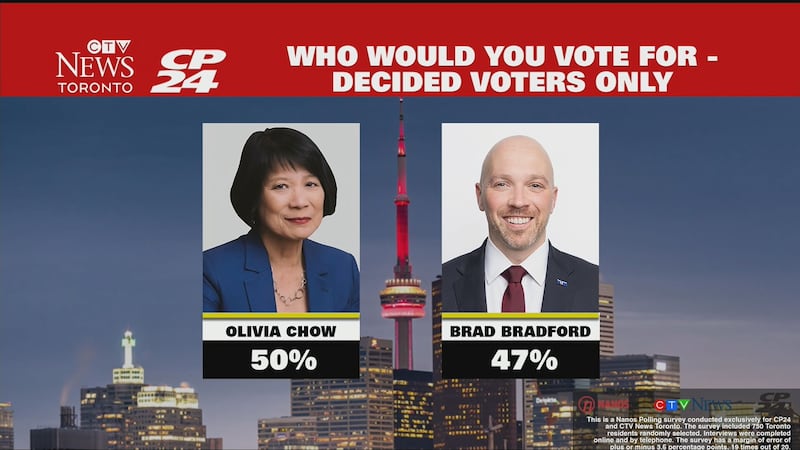
Olivia Chow’s lead over Brad Bradford has narrowed and is now within the margin of error with less than a week to go before the municipal election, according to a new poll conducted exclusively for CP24 and CTV News Toronto. Nanos Research surveyed 762 adult Toronto residents between Oct. 15 and Oct. 18. It found that 49.8 per cent of decided voters support Chow compared to 46.6 per cent for Bradford. Another four per cent of respondents said they would support another candidate. Chow’s support among decided voters is down one point from a Nanos Research poll released last week while Bradford is up nearly a point. The margin of error for the survey is plus or minus 3.6 percentage points, 19 times out of 20. That means the race is now effectively a statistical tie. CTV News Chief Data Scientist Nik Nanos said in a statement that the “deciding factors” in the race will be debate performance and “organizational muscle to deliver supporters.” ‘Toronto Decides: The Municipal Debate’ will be broadcast LIVE on CP24, CP24.com and the CP24 app on Oct. 22 at 7 p.m. “It is going to be a mad dash to the finish for both Chow and Bradford,” Nanos said in an interview with CP24 on Tuesday. “The fact of the matter is that when we look at the margin of error for this survey it is very close, within the margin when we look at decided voters. This race has really tightened up in the last while and this debate that is coming up on Thursday, the CP24 debate, could be the defining moment of the whole campaign. It could decide who will be the next mayor.” Chow had a nearly 10-point lead over Bradford in a Nanos Research poll released on Oct. 6, but has since seen that cushion narrow in the wake of former federal cabinet minister Chris Alexander suspending his campaign later that same day. The latest poll puts Chow ahead in both Scarborough (50.9 per cent) and downtown and East York (58.2 per cent), but Bradford leads in North York (54.1 per cent) and Etobicoke (52.9 per cent). Chow has the support of more than 55 per cent of the youngest respondents (ages 18 to 34) while Bradford is the preferred choice among Torontonians 35 to 54 (52.2 per cent) and 55 plus (49.7 per cent). Undecided voters still loom large, with 16 per cent of respondents to the poll saying they are still not sure who they will support. That is, however, down significantly from the 22 per cent of respondents who identified themselves as undecided in the poll released on Oct. 6. In his interview with CP24, Nanos said that the probability still favours Chow “just because she has an advantage numerically” but he said that the race is “not over by any stretch.” As the campaign enters its final days, Nanos said that he will be paying close attention to how voter sentiment might shift in the key battleground of Scarborough where Bradford has cut into Chow’s lead. “At the beginning of this survey (on Oct. 6) Chow was ahead in Scarborough, comfortably ahead and there was a significant portion of undecided voters. What the poll and the tracking suggests is that Bradford has made inroads among undecided voters in Scarborough and he has been able to tighten the race,” Nanos said. “Chow has got to fight back in Scarborough because she needs to do well in Scarborough in order to hold on to an advantage.” Candidates react to latest numbers The release of the latest Nanos Research poll comes with just six days left in the mayoral campaign. Reacting to the poll at a campaign announcement on Tuesday morning, Bradford said that it is clear that the race is “extremely tight” and that the final stretch of the campaign will matter. “Some polls are up, some polls are down, whatever it may be of course the only poll that matters is on election day,” Bradford said. “My message is it is very, very tight and if you want change grab everybody, your family and friends, folks on the street, people at the office, the job site, get them out to the polls and vote for change.” Chow also spoke about the poll results at a campaign announcement in East York on Tuesday morning where she dismissed any suggestion that the momentum behind her campaign has faded. “The poll, really the most important poll is on election day which is six days away right? That is the one that counts. It is the people that count, not the poles,” she said. Chow’s supporters more motivated to vote As part of the latest survey, Nanos Research also asked respondents how likely they were to actually cast a ballot. It found that Chow has a four-point advantage among those most likely to vote while Bradford similarly leads by four points among those less certain that they will show up at the polls. Nanos Research also asked respondents how they view Toronto. A majority of respondents (57 per cent) said that “Toronto has some issues but its still where I prefer to live, representing a five point increase from previous polls. The percentage of respondents who said that “Toronto is a great city and I wouldn’t want to live anywhere else” dropped from 26 per cent on Oct. 6 to 20 per cent in this latest poll. There has also been a rise in respondents who said they are considering leaving Toronto, from six per cent on Oct. 6 to eight per cent in the latest poll. Bradford has largely campaigned on this being a change election, telling reporters on Monday that Chow has “put nothing forward in this campaign” and “may as well stand in front of a banner that says mission accomplished.” Chow, for her part, has said that her strategy for the final days of the campaign is to “talk about how we have worked together to make life more affordable.” She has characterized the election as a “simple choice” between “making life more affordable for our city” or risking going “backwards.” Methodology CP24/CTV News Toronto/Nanos conducted a RDD dual frame (cell- and land-lines) hybrid random telephone and online survey of 762 residents of Toronto aged 18 years and over, from Oct 15 to Oct. 18. Respondents were all randomly recruited through a dual-frame (cell- and land-line) RDD sample using live agents. One half of the sample was administered the questionnaire by telephone, and one half was administered online through the Nanos Insights Lab Probability Panel. The random sample was weighted by region, age and gender according to the latest Canadian census data. The full methodology is detailed in the technical note in this report. This research was conducted and released in accordance with the standards of the CRIC of which the firm is an accredited member. METHODOLOGY A random survey of 762 residents of Toronto is accurate ±3.6 percentage points, plus or minus, 19 times out of 20.