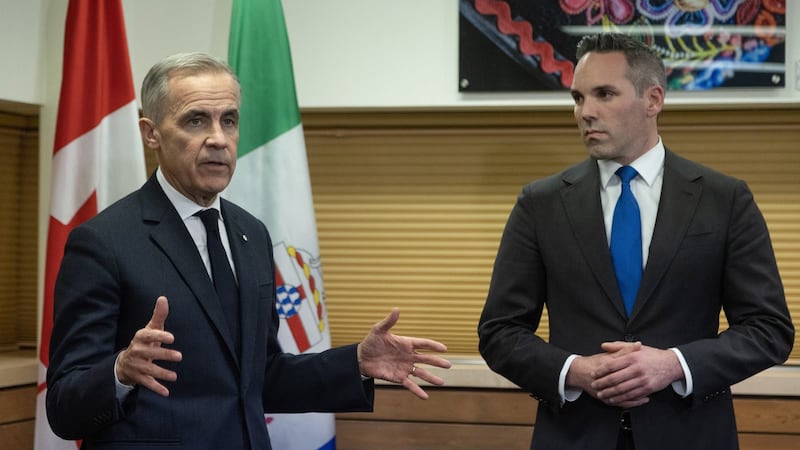
OTTAWA - Prime Minister Mark Carney has officially deemed the Mackenzie Valley Project as a project of national interest, the first in Canada’s north. The government says the 800-kilometre proposed highway would improve access for more than 10,000 people, including providing year-round road access to 2,000 people in the three Northwest Territories (NWT) communities of Tulita, Normal Wells and Fort Good Hope for the first time. The government estimates a trip between Yellowknife and Inuvik will take 23 hours instead of 38, by cutting out 1,300km of travel time. It will take 900 fewer kilometres to get from Inuvik to Edmonton. The highway would run the length of the Mackenzie Valley in the NWT, linking Highway 1 at Wrigley and connect with the Dempster Highway, south of Inuvik. The government says the project also requires new bridges to be built, including across the Great Bear, Liard and Mackenzie rivers. The government estimates the construction price for the northern and southern sections to be $4.2 billion. That does not include the costs of the new bridges nor ongoing maintenance, which could be substantial. The recent federal budget earmarked $3.1 billion for the highway over the next five years. The budget promises to “fully fund the construction and certain maintenance costs” of the highway. Officials at a technical briefing for reporters ahead of the announcement, could not say how much in maintenance costs the government is prepared to cover, nor for how long. Ottawa has also promised to launch a new Crown corporation to manage major projects including the highway. The budget earmarked $187M over the next five years for the entity, and $24M in future years. It’s not clear when exactly that entity will be functioning. New highway’s prospective benefits The government believes the highway would substantially impact the NWT’s GDP, reduce freight costs, stabilize the cost of living, and open up trade in the NWT and with other provinces and territories. The highway is also expected to boost tourism by providing a new scenic route through the NWT and Yukon. In terms of security and defence, the government says the highway will support the Canadian Armed Forces to move more easily and help build defence infrastructure in the North. An official at the briefing said that “global shifts in geopolitics and security are contributing to new vulnerabilities for the Arctic and North region,” and that Canada must “act ambitiously” to “demonstrate its sovereignty in the region.” The highway project has been a topic of discussions and debates for decades. However, the Carney government takes credit for moving it along “at a pace not seen in generations,” according to a press release announcing a $405M cash injection in September. That funding includes some money towards the three bridges. Related construction is already underway, including work to resurface Highway 1 toward Wrigley. The Oscar Bridge relocation and Christina Creek realignment will start once the winter road is built in early 2027. What comes next? The government says next steps include finishing an environmental assessment that first began in 2013 and continued Indigenous consultations, although government sources said they were satisfied they had “fulfilled the duty to consult” when making the decision to list the project one of national interest. Officials said they expect the environmental review to wrap by the end of 2027, noting some “challenges” in terms of being able to meet some communities in person. Drug and alcohol access a ‘key concern’ In community consultations done so far, government officials said “a really key concern” is around the ease of drugs and alcohol coming into communities, as well as a lack of policing. The official said the federal government is committed to “supporting where we can,” and that the government of the NWT will be working with communities and organizations along the route to address this. Wednesday, the federal government signed a framework deal for co-leadership, called a Leadership and Governance Understanding (LGU), with Gwich’in Tribal Council, Sahtu Secretariat Incorporated, Pehdzéh Ki First Nation and the Government of the Northwest Territories (GNWT). The LGU aims to have as much Indigenous participation and job opportunities for northern businesses and workers as possible. At the peak of construction, the major projects office estimates the project will need 3,000 workers. Listing a project in the national interest is supposed to speed up the entire process and streamline federal approvals. The highway is the third project to officially be deemed in the national interest, along with the Pacific Link pipeline between Alberta and B.C., and the Roberts Bank Terminal 2 expansion in Delta, B.C.