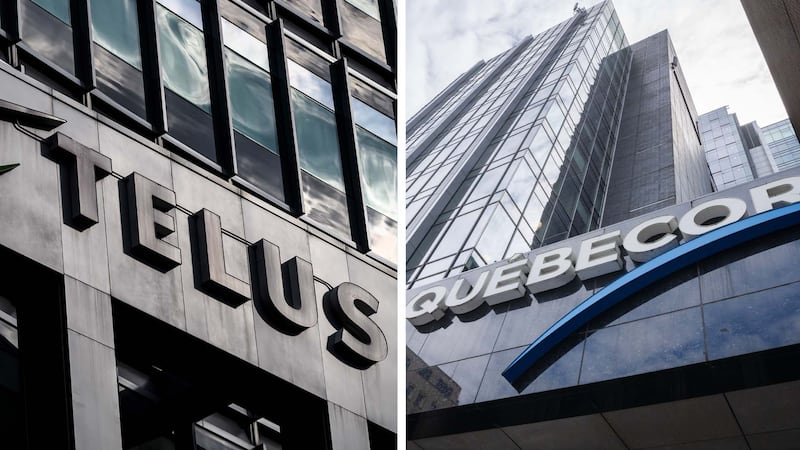
MONTREAL — Quebecor Inc. is proposing a merger with Telus Corp. in a cash-and-stock deal valued at about $31 billion, but competition concerns could stand in the way of a potential transaction. The Montreal-based company said Monday the proposed deal would combine complementary networks, spectrum and operations to boost investment capacity and create a more competitive company. But Telus chief executive Victor Dodig said in an interview that the company has “serious concerns” with Quebecor’s proposal, with the “largest hurdle” being regulatory issues. He said the offer also “doesn’t nearly reflect the value of Telus.” “I think this is all about the resilience, strength, sovereignty, and safety of the telecom sector in Canada. This does not advance that at all,” Dodig said. Telus said its board of directors has formed a special committee of independent directors to review and evaluate the Quebecor proposal and explore other strategic alternatives. Quebecor estimates the proposed takeover would create around $160 million in annual operating cost savings and $235 million in annual capital savings, on top of Telus’ recently announced goal of achieving approximately $900 million in savings per year moving forward from the end of 2028. It said those efficiencies would support new spending on network upgrades, integration with Canadian satellite networks and service enhancements. It would also go toward the deployment of artificial intelligence, data centres and advanced connectivity infrastructure. Asked about Quebecor’s goal of finding savings so that a potential combined company could spend more on infrastructure and new technologies, Dodig said that’s something his company already has “completely under control.” “In my estimation, every single point of their offer has serious complications,” he said. Industry Minister Mélanie Joly said in a statement on Monday that the transaction will be “rigorously reviewed.” “We will not predetermine the outcomes of the reviews related to this or any other specific transaction,” the statement said. “In the face of accelerating technological change, global instability and ongoing cost-of-living pressures, the Government of Canada will relentlessly prioritize the best interests of Canadians and Canadian sovereignty.” Quebecor said it made a non-binding proposal to Telus on June 26 to serve as the basis for negotiations and then submitted what it called an “enhanced proposal” on Nov. 9. Under the offer, Telus shareholders would receive $6.35 in cash and 0.17 class B shares of Quebecor for each Telus share. Quebecor said the bid is worth $19.45 per share based on its closing share price on Friday. Telus shares closed at $12.14 on Friday. Scotiabank analyst Maher Yaghi said a potential deal would face significant obstacles, pointing to likely reviews by the Competition Bureau, the CRTC and Innovation, Science and Economic Development Canada. He said additional federal reviews or approvals could also be required “given the strategic nature of Canadian telecommunications infrastructure.” Telus noted that even if such a deal received regulatory approvals, it may be subject to certain conditions that “materially affect the combined company.” If a merger between Quebecor and Telus moved forward, it would be the largest takeover in Canada’s telecommunications sector since Rogers Communications Inc. purchased Shaw in 2023. As part of that $26-billion takeover, Quebecor’s Videotron subsidiary acquired Freedom Mobile from Shaw. Rogers and Shaw agreed to sell Freedom to Videotron to ease competition concerns raised by the original proposal. Both of those transactions came with a list of conditions meant to protect competition in the telecom sector. They included Rogers establishing a second headquarters in Calgary and adding 3,000 new jobs based in Western Canada that it must maintain for at least 10 years. Rogers was also required to spend billions to expand 5G coverage and additional network services, as well as to connect rural, remote and Indigenous communities. Dodig said Telus is drawing lessons from the Rogers-Shaw merger, which took more than two years to come to fruition after it was initially proposed as the companies involved worked to address government and regulatory concerns. “We’re all modernizing our businesses, our way of life. The telecom sector and Telus’ role in it needs to kind of stay at the forefront, not get caught up in some sort of regulatory morass that’s going to take years,” Dodig said. As part of the Rogers-Shaw merger, Videotron was required to offer plans at least 20 per cent lower than its competitors and spend $150 million over two years to upgrade Freedom Mobile’s network. It is also restricted from transferring any Freedom Mobile licences for a decade. Quebecor said that it “has fully performed the undertakings it made” to Ottawa since that deal, while demonstrating its ability “to combine growth, pro-consumer pricing and innovation.” It noted that wireless prices fell 35.4 per cent in the three years following the acquisition of Freedom, according to Statistics Canada. “Providing Canadians with a stronger competitor, capable of investing more, while continuing to offer wider choice, including by maintaining the Telus brands, as well as healthy competition and real value, will remain at the core of the combined company’s DNA,” Quebecor said. Combining two of Canada’s four largest wireless service providers “would undo the competitive structure regulators set up when they required Freedom to be divested as part of the Rogers-Shaw approval,” Scotiabank’s Yaghi said in a note. “Without meaningful remedies, the deal runs against the government policy intent behind the Freedom transaction,” he said, adding that approval could be contingent on Quebecor offering “significant concessions to the government” to keep telecom prices low. “Regulatory decisions will make or break the deal, not price. If Quebecor is not ready to let go of Freedom Mobile, we believe this deal has a low chance of going through.” Quebecor’s share price fell about 14 per cent or $10.44 to $66.62 in morning trading on Monday. Telus’ share price jumped about 12 per cent or $1.46 to $13.60. --- Sammy Hudes, The Canadian Press This report by The Canadian Press was first published Nov. 16, 2026.