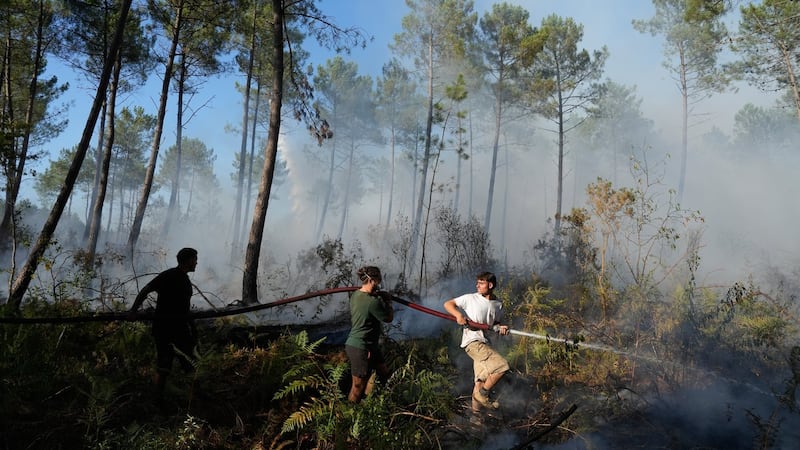
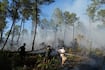
LEGE-CAP FERRET, France -- French authorities ordered 4,000 more people evacuated from Atlantic coast tourist sites Tuesday, widening what may be France’s largest peacetime evacuation as returning heat threatened firefighters’ fragile hold on a vast wildfire west of Bordeaux. Fire crews held the blaze in the Gironde region in check through a calm night, bringing flare-ups near coastal dunes under control and keeping the burned area unchanged at 420 square kilometres (162 square miles). Authorities called the fire stabilized, but not contained, and said it was still capable of breaking loose as temperatures rose and humidity fell. Fresh flames erupted later Tuesday near Grand Crohot, a popular vacation beach on the Lege-Cap-Ferret peninsula, local authorities said. Firefighters backed by water-dropping aircraft battled the renewed flames to keep them from spreading. “The situation remains complicated. That’s clear. We’re not out of the woods,” Gironde prefect Sophie Brocas said. Brocas said residents evacuated from three communities near Bordeaux where no fires had broken out were being allowed to go home, but only if they kept their mobile phones on and an emergency bag packed. Across France and Spain, roughly 330,000 people have been driven from homes and vacation sites by huge wildfires. Spain braced for its fourth heat wave of the summer, with several blazes still burning out of control, including the largest in its recorded history. Even so, Spanish authorities began lifting evacuation and stay-at-home orders for thousands of people after firefighters made progress overnight. The Gironde fire has burned an area four times the size of Paris and forced 220,000 people to evacuate. Interior Minister Laurent Nunez has said it is “very likely” the largest civilian evacuation operation carried out in the country outside war. Evacuations don’t deter some vacationers The precautionary evacuation order covered campsites, holiday villages, tourist residences and leisure parks around the resort of Lacanau, Gironde regional authorities said. “We are at a point of fragility,” Eric Brocardi, spokesperson for France’s national firefighters federation, told the BFMTV broadcast network Tuesday. “We will continue attacking this fire despite the forecast rise in temperatures.” Even as nearby homes burned and authorities urged tourists to stay away, one family told Le Parisien newspaper it had gone ahead with its trip rather than forfeit a 4,000-euro (US$4,558) holiday, while another group debated abandoning a vacation that had cost 650 euros (US$741) each. A fire making its own weather At its most violent, the Gironde blaze built a gargantuan black thundercloud, electrified and lit from within. It generated lightning, violent winds and new fires beyond the original front -- the first such storm ever recorded in France. France’s national weather service placed Gironde under a yellow heat warning beginning at midday Tuesday, forecasting inland temperatures of 33 to 35 C (91 to 95 F). More than 1,160 square kilometres (448 square miles) have burned across France this year, according to the Interior Ministry. Europe is the world’s fastest-warming continent, heating at more than twice the global average, according to the European Union’s Copernicus climate service. Western Europe recorded its hottest June on record, with extreme heat and widespread dryness contributing to the spread and intensification of fires in France and Spain, Copernicus said. Crews defend homes and cut firebreaks In Le Porge alone, west of Bordeaux, the municipal government said about 150 homes were destroyed. Officials warned that smoldering vegetation, rising temperatures and falling humidity could produce fresh outbreaks along the fire’s vast perimeter. Military engineers and forest-fire prevention crews resumed cutting firebreaks early Tuesday. Authorities said crews had completed 103 kilometres (64 miles) of firebreaks. At least 110 firefighters have been injured, the prefecture said. Thousands return as second fire stops advancing In Landes, about 15,000 evacuees -- half the total -- were allowed home after a separate wildfire stopped advancing. “The fire is fixed, which is good news in Landes,” French President Emmanuel Macron said Monday evening. Regional authorities said that meant its advance had been stopped and there were no new fire starts. Those allowed back included residents of Sanguinet, Parentis-en-Born, Biscarrosse’s aviation village and a large campground. Several other neighbourhoods remained inaccessible. Authorities warned that the Landes fire was not extinguished. Residual hot spots, wind and drought could cause flare-ups, and surveillance and damping-down operations were expected to continue for days or possibly weeks. Thousands begin returning in Spain Spanish firefighters made progress Tuesday, and authorities began lifting evacuation orders for at least 20,000 of the 79,000 people forced to flee over the weekend. Francisco Martin, the central government’s representative in the Madrid region, said orders would be lifted in 10 towns, allowing about 20,000 evacuees to return home and ending stay-at-home orders for another 14,000 people. Residents of some villages in Avila were also being allowed home, though authorities did not specify how many. Another 6,000 people could return after a smaller fire near Toledo was brought under control, while several thousand more went home in Castellon. Hundreds of firefighters backed by military emergency brigades and water-dropping aircraft continued battling several major wildfires. Smoke from the fires reached Madrid in recent days. Emergency services said residents in central and eastern districts could smell smoke and ash. Spanish Interior Minister Fernando Grande-Marlaska said Tuesday that nonstop work through the night left him “reasonably positive,” though officials warned that crews had only a brief window before extreme heat returned. Spain’s national weather service said the country was bracing for its fourth heat wave of the summer, with temperatures expected to exceed 40 C (104 F) in some areas. The government declared a national emergency over the fires. At least 13 people have died in wildfires in Spain this year, making 2026 one of the country’s deadliest fire seasons in decades. “I’ve been living in San Martin de Valdeiglesias for 20 years and I never thought I would see this,” said Estella Costales, an evacuated resident staying at a temporary shelter in Brunete, near Madrid. “It’s unfortunate, but I never thought I would see such destruction.” Surroundings of Madrid remain at risk The greatest concern remained two large fires that had at times come close to merging into a single blaze in wooded hills about an hour’s drive west of Madrid. A fire in hilly, rural terrain in Avila, west of Madrid, has become Spain’s largest on record, scorching more than 500 square kilometres (193 square miles), the government said. Another fire in the eastern province of Castellon also forced mass evacuations. “Look at how the valley is burned. Look at the houses, the people,” said David Gonzalez, a 48-year-old gardener who used his van to deliver supplies to firefighters in Avila. “We are feeling a lot of anger and helplessness. It’s something inhuman,” he said. Fires have burned 1,530 square kilometres (590 square miles) this year in Spain, Ecology Minister Sara Aagesen said. Spanish Prime Minister Pedro Sanchez has called for a national pact to fight wildfires, saying climate change is making them worse. ___ Thomas Adamson, Mark Carlson and Emma Da Silva, The Associated Press Adamson reported from Paris. Joseph Wilson in Barcelona, and Iain Sullivan in Brunete, Spain, also contributed to this report.