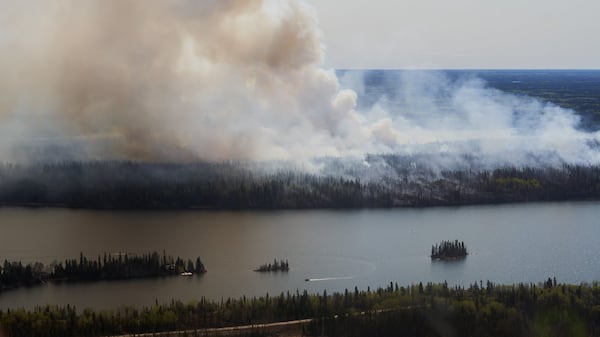
OTTAWA — The impacts of climate change in Canada are now largely irreversible and average temperatures are expected to rise by at least 3.5 C by the end of the century, a new government report warns. The report, published Thursday, is the second released by Environment and Climate Change Canada examining changes to Canada’s climate. It was authored by nearly two dozen government and climate science experts. It says that even if the world reaches net-zero emissions by 2075 — which would mean any greenhouse gases would be captured by nature or technology — the effects in Canada will be stark. The report says those effects include a nearly 50 per cent increase in the area burned by wildfires and glaciers in Western Canada losing more than 75 per cent of their mass. “The most surprising thing is the contrast between what the report says that we can expect for our future climate, and the level of action that the federal government and other governments in Canada are taking,” said Ryan Ness, adaptation research director at the Canadian Climate Institute. With the climate policies now in place around the world, average temperatures in Canada are expected to rise five degrees by the year 2100, with a 50 per cent chance that winter temperatures will increase by more than 10 C in much of Nunavut. “That’s a lot of climate change that we have to adapt to and we’re not ready for it,” Ness said. “We’re already seeing how vulnerable we are to the climate-driven disasters that we’ve experienced over the last few years. It’s only going to get worse, and yet the pace of action on adaptation is not high.” Ness said adaptation should include things like retrofitting homes with more fireproof material and building firebreaks and flood walls around communities. In a report issued last year on Canada’s national climate adaptation strategy, Canadian environment commissioner Jerry DeMarco said Ottawa’s efforts to prepare the country for the impacts of climate change had stumbled out of the gate. DeMarco’s report concluded the strategy was not effectively designed and did not prioritize Canada’s climate change risks, and that departments relied instead on existing priorities and consultations. DeMarco cited the short-term health impacts of wildfire smoke, estimated to cost between $410 million and $1.8 billion annually between 2013 and 2018. He also remarked on the spike in Lyme disease cases from 144 in 2009 to 2,525 in 2022 -- an increase of more than 1,500 per cent. A progress report on the climate adaptation strategy released by Ottawa last month said there are hundreds of new flood-mapping projects underway to better identify flood-prone areas. It also acknowledged that 94 per cent of people living in high-risk areas don’t yet know their home is susceptible to floods. The new report released Thursday says droughts and flash floods will become more frequent and severe as temperatures rise. “Canada’s latest state of the climate report is a stark warning of what Canadians will face if governments fail to tackle the climate crisis with the urgency it requires,” said Julia Levin, associate director of national climate at Environmental Defence. “This report should be a call to action. What the future looks like for our children depends on the policy choices being made today. The worst impacts of climate change are far from inevitable.” Prime Minister Mark Carney has been accused of backsliding on climate policy for the better part of the last year. He eliminated the consumer carbon price in March 2025, on his first day in office. While he promised a strengthened industrial carbon pricing system, he was accused of weakening that system through an agreement with Alberta in May that has ramifications for every other province and territory. His government is also moving to repeal the electric vehicle sales mandate -- Ottawa has promised stronger tailpipe standards but those are still years away -- and to cancel the oil and gas emissions cap. Carney’s government also has delayed new methane regulations in Alberta. Carney has said federal climate policy under former prime minister Justin Trudeau was too expensive and divisive and “not sustainable over the long term.” In response to Thursday’s report, the office of Environment Minister Julie Dabrusin said the government is still committed to reaching net-zero by 2050. “To protect Canadians from the impacts of climate change and severe weather, the federal government has committed more than $2.1 billion to implement the National Adaptation Strategy and support a wide range of adaptation-related activities,” said Chris Zhou, Dabrusin’s director of communications. “Our government is moving with urgency to fight climate change, while working together to build the energy security, industrial capacity, and strategic autonomy that will define this century for Canada.” This report by The Canadian Press was first published Sept. 4, 2026. Nick Murray, The Canadian Press