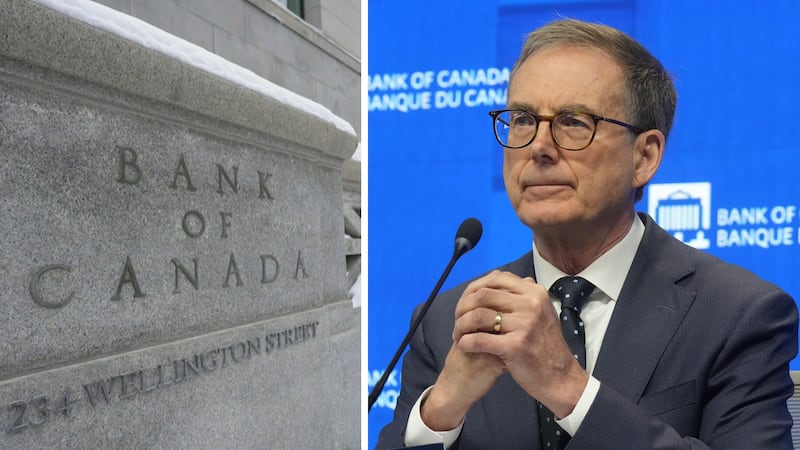
Expectations are rising that the Bank of Canada will indeed raise its benchmark interest rate this week as it considers the effect of higher energy prices on the economy. Financial market odds for a rate hike were just over 83 per cent as of Monday afternoon, according to LSEG Data & Analytics. The central bank’s planned interest rate announcement on Wednesday will also include an updated monetary policy report. The Bank of Canada has held its policy rate at 2.25 per cent for seven consecutive meetings. RBC economists said in a note to clients Thursday that they are now expecting a quarter-point hike as the central bank faces a “pivotal decision amid evolving economic conditions.” Last week, Statistics Canada reported the annual inflation rate rose to 3.1 per cent in September as the war in the Middle East continued to drive up gasoline prices. Excluding gasoline, the consumer price index rose 2.2 per cent year-over-year in September, easing from 2.4 per cent in August, suggesting higher energy prices haven’t significantly spread throughout the economy yet. Meanwhile, jobs data from StatCan released earlier this month showed the labour market stalled for a second month in a row in September as the economy lost 68,000 positions. However, the RBC economists said they have “very low conviction” on a rate hike happening this week, and see a significant chance the Bank of Canada instead uses the meeting to set up a hike in December or January. “While we don’t see an immediate need for the BoC to hike now, at the same time, a 25-basis-point increase in the overnight rate on Wednesday won’t materially change our medium-term economic outlook compared to a December or January hike,” the note reads. RBC assistant chief economist Nathan Janzen said in an interview that recent comments from Bank of Canada governor Tiff Macklem appeared to drive the change in expectations. While speaking from the sidelines of the International Monetary Fund meetings in Bangkok, Macklem warned that persistently high global energy prices will drive up the inflation outlook at home. “That essentially just emphasized that the central bank is increasingly worried about the potential impact of higher oil prices on future, broader inflation pressures, and they feel confident enough the economic backdrop is going to gradually continue to improve,” Janzen said. The Bank of Canada released its latest business outlook survey last week, which suggested that business sentiment improved on average in the third quarter. However, it found that concerns remained about rising costs and the war in the Middle East. “All the economic data that we’ve had to date is consistent with the view that the central bank, the Bank of Canada, was getting closer to raising interest rates,” Janzen said. Canadian interest rates are still relatively low, he added, and the neutral range — where rates are neither helping nor hurting the economy — sits between 2.25 per cent and 3.25 per cent. TD Bank economist Marc Ercolao said in an interview that it is clear the Bank of Canada is becoming more concerned about the persistence of rising energy prices, “and that’s what’s starting to change the calculus.” While a hike is likely, he said there are also arguments for the bank to hold its key rate. “There’s interest-sensitive parts of the economy, particularly housing, that are already dealing with higher bond yields and too much additional tightening risks some unnecessary weaker demand in that space,” Ercolao said. “Overall, Canada’s economy is growing, but it’s not necessarily overheating by any means.” The impact of U.S. trade tensions on overall investment and a weakening labour market also support a decision to hold interest rates, he said. He said a hike on Wednesday would be a risk management measure to prevent the inflation shock from becoming more persistent. Ercolao said higher energy prices are a double-edged sword for the domestic economy. “On one hand, higher energy prices are good for producers and government, and corporate revenue intake. It creates higher incomes especially in commodity-producing provinces,” he said. “But at the same time, it’s households especially that feel the pinch immediately from higher gasoline costs and then secondary to that, higher refined product costs end up feeding through the supply chain and into our end-user purchases.” Ercolao said that Canada has navigated the trade dispute “fairly well” by diversifying trade in certain sectors, including shipments of energy products to Asia and Europe. “That said, there’s still that acute pressure that’s being placed on very reliant industries in Canada on the U.S., especially in Central Canada like Ontario and Quebec with our steel industry, our aluminum industry and our auto industry,” he said. --- Daniel Johnson, The Canadian Press This report by The Canadian Press was first published Oct. 26, 2026.